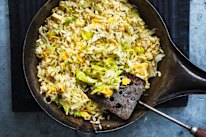
Naff or underrated? Adam Liaw reckons it’s time to serve this Aussie classic with pride
Shake off the cultural cringe and put these true-blue Aussie curried sausages back on the dinner table.

Bring back curried sausages! The great Australian curried snag might be our most underrated dish, and rather than considering it a relic of the past, it deserves to be a modern, constant, and evolving part of the Australian food canon. Here’s how to make great curried snags.
Ingredients
1 tsp vegetable oil
6-8 thick beef sausages
40g butter, plus extra to serve
2 medium brown onions, sliced thinly
1 carrot, cut into 1cm rounds
3 tbsp plain flour
2 tbsp Australian curry powder (such as Keen’s or Clive of India)
500ml chicken or beef stock, or water
2 tsp worcestershire sauce
1 tbsp tomato sauce
1 cup frozen peas
salt and black pepper, to season
steamed rice, to serve (see note)
¼ cup fruit chutney, piccalilli or pickled onions, to serve (optional)
Method
Step 1
Start by heating a large, low casserole dish or frying pan over low-medium heat. Add the oil, then place the sausages in the pan, and cook them for about 10 minutes, turning them regularly with tongs until they’re golden brown on all sides and cooked through. Once done, remove them from the pan and set them aside.
Step 2
Reduce the heat to low. Add the butter to the same pan, stirring to combine it with the fat rendered from the sausages. Add the onions and carrots, cooking them for about 3 minutes, stirring often, until they begin to soften.
Step 3
Stir the flour and curry powder into the vegetables and cook for 2 minutes. Stir in the stock, worcestershire sauce, and tomato sauce. Bring the sauce to a gentle simmer, cover the pan, and continue to simmer for 5 minutes, or until the sauce has thickened, and the carrots have softened.
Step 4
Cut the sausages into 2cm-wide rounds and return them to the pan. Stir in the peas and simmer for about 3 minutes. Taste the curry and season with more salt and black pepper if needed.
Step 5
Serve with steamed rice topped with a pat of butter, and some fruit chutney, piccalilli or a few pickled onions on the side.
Masterclass
Cumin and going
While the spices found in curry powder hail from South Asia, the concept of “curry powder” itself is a distinctly British innovation. In the late 1800s, these homogenised blends were created for European markets where consumers were unfamiliar with using the individual spices they contained.
The best recipes from Australia's leading chefs straight to your inbox.
Sign upIn Australia, the two most popular curry powders are Keen’s, invented in the 1860s in Hobart, and Clive of India. They are different formulations, but they have one thing in common that differentiates them from many other curry powders – a lack of cumin.
Cumin is a staple spice in countless South Asian dishes, but it’s conspicuously absent from Keen’s and a very minor player in Clive of India (present in a smaller quantity than even the chilli). I think it’s the lack of cumin in these powders that gives curried sausages their distinctively Australian taste.
An Australian classic
Curried sausages are a true Australian classic, and it’s a shame we tend to see them as a bit old-fashioned. They are, in fact, our very own “Australian curry”, and they deserve a proud place in our culinary culture.
They became popular in Australia around the mid-20th century when curry powder was the hottest (pun intended) ingredient around. The reach of the British navy, combined with post-war British popularity and Indian independence in 1947, saw “curry” spread around the world like wildfire.
It saw the rise of dishes such as currywurst in Germany (1949), curried fishballs, brisket and Singapore noodles in 1950s Hong Kong, Japanese curry roux blocks (1950), and even featured in the Coronation Chicken created for the Queen’s 1953 coronation. Our curried sausages predate all of these.
Deep-seated cultural cringe means we continually fail to recognise Australian food as being worthy on the global stage. Could more than 75 years of pride and evolution of curried sausages have turned them into multi-billion-dollar global industries like currywurst or Japanese curry? We’ll never know, but rather than considering them a bit naff, we should embrace our Australian curried snags with the pride they deserve
Chutney or pickle?
While many 1950s recipes were sweeter than we might prefer today, a bit of sweetness is essential for a balanced curried sausage dish. I recommend adding tomato sauce to the dish to achieve this, and then serving it with a spoonful of good old-fashioned fruit chutney.
Around the world, braised curries are often paired with a piquant condiment to provide a contrast. Think of raita, kachumber, mango chutney, or lime pickle with South Asian curries, or pickled vegetables such as fukujinzuke and rakkyo that are served with Japanese curry.
I like to serve curried sausages with a spoon of something similar – fruit chutney, Branston pickle, pickled onions or piccalilli – to round it out.
Mash or rice?
This is entirely your own decision, but I think buttered rice is a perfect accompaniment, if for no other reason than it’s easier to cook. It also means you can add chunks of potato to the curry, an excellent addition.
Having thought about this for far longer than a normal person should, I have come down firmly in favour of [cutting the sausages into] thick rounds.
Making the cut
When it comes to cutting sausages for your curry, there’s a surprising number of choices. Some recipes suggest leaving the sausages whole, some recommend cutting them into 5cm pieces, some suggest meatball-sized chunks, and others suggest slicing them on an angle.
Having thought about this for far longer than a normal person should, I have come down firmly in favour of thick rounds.
The decision comes down to the cutlery used to eat this dish. For me, a fork and a spoon are the best choice.
Larger pieces of sausage need a knife and fork because cutting a sausage with a spoon is an exercise in disappointment. But if you’re using a knife and fork for curried sausages, that limits you to serving your curried sausages with mash, as trying to eat rice and peas with a knife and fork is more humiliation than I can handle on a weeknight dinner.
Cutting sausages on an angle – or obliques –is a practical choice, especially for thinner sausages. This gives the sausage a greater visual presence on the plate.
But for the perfect balance, I recommend cutting thick sausages into rounds slightly wider than your carrots. This gives you the best of all worlds: visual harmony with the carrots, clear focus on the sausages as the main event, and ease of eating with just a fork and spoon. Did I mention that I may have overthought this?
Get creative
The potential variations to curried sausages are endless.
- Add different vegetables, such as cubes of potato, Brussels sprouts, canned kidney beans or even diced Granny Smith apples.
- Change the sauce entirely. Try a butter chicken-inspired gravy using tomato passata and cream, finished with dried fenugreek leaves.
- Swap the curry powder and stock for red or green curry paste and coconut milk, adding fresh Asian herbs to give it a Thai influence. Or, for a quick and easy option, use Japanese curry blocks.
- Switch out the sausages themselves. Australian butchers offer an incredible variety of flavoured sausages that can completely transform the dish.
More:
 Adam Liaw is a cookbook author and food writer, co-host of Good Food Kitchen and former MasterChef winner.